

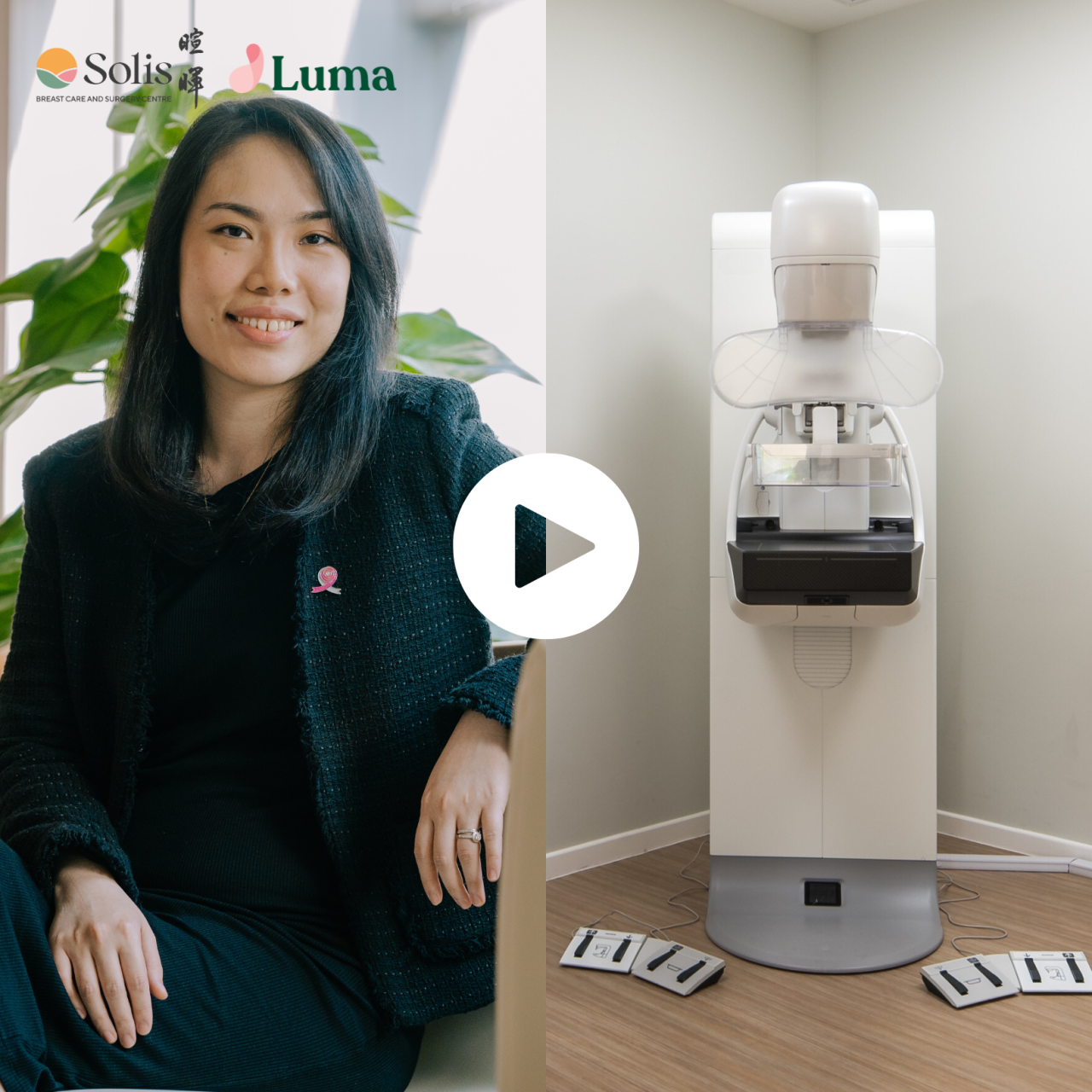
How Mammogram & Ultrasound Provide Peace of Mind

Providing peace of mind: Breast screening for early cancer detection One in 13 women in Singapore will develop breast cancer in their lifetime [1]. It is very likely that you know someone who is living with or caring for a breast cancer patient. Regular breast screening with mammograms and/or ultrasounds is key to identifying subtle abnormalities on imaging before they manifest into advanced symptoms. Treatment of breast cancer in the early stages are associated with better outcomes with reduced morbidity and mortality rates. Mammograms for Early Detection of Breast Cancer Mammographic screening is the most reliable and cost-effective modality for detecting early breast cancer. It involves taking low dose x-rays of the breast tissues. Screening mammograms are done for women with no symptoms to look for early signs of breast cancer. On the other hand, diagnostic mammograms are performed to assess women with symptoms such as breast lumps, nipple discharge and/or skin changes. Regular mammographic screening has been proven to be instrumental in reducing the risk of mortality associated with breast cancer. Mammographic screening should be performed every year for women aged between 40 and 49, and every two years for women aged 50 and above [1]. What is a 3D Mammogram? 3D mammograms (also known as digital breast tomosynthesis) involves using low-dose x-rays shot through a continuous arc to obtain multiple slices of images through the breast. These are then reconstructed into a scrollable image stack for evaluation. 3D Mammograms are More Comfortable There are multiple advantages of 3D mammograms over standard 2D mammograms, which is why we advocate for its use in screening at Luma Women’s Imaging Centre. Compared to 2D mammograms, 3D mammograms offer greater diagnostic accuracy resulting in increased cancer detection. This is especially significant for women with dense breasts, which are very common in the Asian population. Due to our ability to scroll through a stack of layered images to differentiate between normal breast tissue and true abnormalities, 3D mammogram reduces the need to recall patients for additional imaging. With our Luma 3D mammogram machines, there is overall reduced radiation exposure in contrast to 2D mammogram. Reduced compression force is required to produce 3D mammogram images; therefore, patients experience improved comfort during the imaging process. Ultrasound: Process and its Benefits Breast ultrasound is an imaging technique that uses sound waves to examine the breast’s internal structures. It demonstrates high sensitivity in identifying breast abnormalities such as cysts, solid masses, abscesses and lymph nodes. Breast ultrasound is often used to supplement a mammogram in evaluation of mammographic abnormalities and/or for assessment of breast symptoms [2]. Breast Ultrasound vs Mammogram Breast ultrasounds and mammograms are two different imaging modalities with different functions, and one does not replace the other. Mammogram remains the gold standard in detecting early breast cancers, which commonly present as calcifications. Breast ultrasound has high sensitivity for identifying small lumps and aids in evaluation of mammographic abnormalities, but is unable to as reliably pick up calcifications. Supplemental breast ultrasound may be considered in the following settings: Women with dense breasts, which are common in the Asian population. Dense breast tissues are difficult to penetrate even with x-rays and are difficult to evaluate with mammograms alone. Pregnant women. Ultrasound does not use ionising radiation like in mammograms, thus making it safer for the developing foetus. Women who are younger than age 40 with strong risk factors for breast cancer [3]. requiring an enhanced breast screening regime. Regular Breast Screening Provides for Peace of Mind Mammograms and breast ultrasounds play a vital role in the early detection of breast cancer and provide peace of mind for women who undergo regular screening. By combining these screening methods, women are empowered to take a proactive approach towards their breast health, ensuring that any subtle abnormalities are being appropriately investigated. By raising awareness, promoting breast care education, and prioritising early detection and prevention efforts, we can work towards a future where breast cancers are diagnosed at an early and most treatable stage. This in turn saves lives and improves the overall well-being of women and our community. 1. Singapore Cancer Society, “Breast Cancer”  2  John Hopkins Medicine, “Breast Ultrasound” 3 Breast Cancer Detection : 3D Mammogram Better Than 2D Scan, Study Finds 
Read more

How a Sub-specialised Breast Pathologist Helps Patients in their Fight Against Breast Cancer

The role that pathologists play in diagnosing breast cancer is a crucial and emotional one. They are the ones who use their expertise to analyse tissue samples that have been excised from patients and determine if they have breast cancer. Professor Tan Puay Hoon shares with us on what her sub-specialisation in breast pathology brings to the table of breast cancer diagnoses and the advantages of being a female pathologist. Ever since she was a student, Professor Tan Puay Hoon has always enjoyed the investigative aspect of making a diagnosis based on the histological appearances of tissue sections evaluated down the microscope. After excelling in pathology during the fourth year of her medical school examination and receiving a medal for the subject, she went on to become a pathologist after her graduate studies. The role that pathologists play in diagnosing breast cancer is a crucial and emotional one. They are the ones who use their expertise to analyse tissue samples that have been excised from patients and determine if they have breast cancer. As a pathologist, Prof Tan ensures that the surgical specimen excised or resected from the patient by the breast surgeon is carefully inspected at the laboratory. Sampling of the relevant specimen parts are also processed into microscopy slides, which are then evaluated using the microscope. “We also render comprehensive reports of cancers that will allow the clinicians to be able to decide on treatment. The pathologist confirms that a breast tumour is malignant (cancer), the types and grades of the cancer, determine its prognosis and whether it will respond to certain treatments,” explains Prof Tan. “Without a pathological diagnosis, patients will not be able to receive appropriate treatment, and surgeons will not know which type of operation to offer the patient for the best outcome. Oncologists also depend on pathology input to decide what type of adjuvant therapy is suitable,” she adds. Pathologists like Prof Tan also advise clinicians on the likely behaviour of cancers (prognostication) and predict if the cancers will respond to specific treatments. “As a woman, I feel privileged to be able to work in a field that impacts women significantly. I empathise deeply with women who are diagnosed with breast cancer, as this disease and its treatment affects their image and so much of the psychosocial aspects of their lives, as mothers, wives, daughters. I want to be able to provide diagnoses that add value to their treatment journey,” says Prof Tan. Early breast cancer diagnosis leads to a higher chance of cure and hence, Prof Tan also advocates breast cancer awareness among all women, young and old.  “Women in the appropriate age group should attend regular breast screening, and all females should seek early medical attention for breast symptoms,” says Prof Tan. As a pathologist, Prof Tan also provides second opinions on cases that are sent for her review. She recounts a recent case in which a relatively young woman was diagnosed with breast cancer on needle aspiration (a small amount of breast tissue or fluid is removed from a suspicious area with a thin, hollow needle to check for cancer cells) and the patient was scheduled for cancer surgery. “The original needle aspiration slides were sent to me to review, and I thought the appearances were benign and possibly a fibroadenoma (a benign tumour),” Prof Tan explains. A core biopsy was conducted to clarify the discordance between the original diagnosis and Prof Tan’s review, which later confirmed that it was a fibroadenoma. “I was so happy for the patient,” says Prof Tan. Given that she holds the hope and well-being of countless women in her hands with each slide she examines, how does she perceive her role as a pathologist? “I would like to think of a pathologist as a ‘cell whisperer’ of sorts – the cells in the tissue are giving clues to their nature, and it is up to us as pathologists to put all this information together. Sometimes the cells are really ugly which often reflects an aggressive cancer. Other times, there are beautiful patterns that remind me of things I see in life,” she says. Since pathology is a very academic discipline, Professor Tan said pathologists need to be at the forefront of all diagnostic development. “Being involved in clinical research is integral to being a pathologist who is current with the developments in the field and also as someone who can offer depth to disease diagnosis,” she adds. Prof Tan also emphasised the important role that pathologists play as educators for the next generation  as well as in conveying pathology information to clinical colleagues. So, what makes Prof Tan feel fulfilled in her job as a pathologist? “I feel fulfilled when I’m able to make an accurate comprehensive diagnosis which allows the clinicians to treat the patients,” she says. Prof Tan also enjoys working with her clinical colleagues who are experts in their fields and collaborating with her pathologist friends and colleagues in the international arena.  She feels gratified to be part of the WHO Editorial Board that classifies breast tumours and is also actively involved in international research that can refine and improve the classification of breast tumours for better treatment.
Read more

What is Preventive Mastectomy and Who Should Consider It?

Does a family history of breast cancer put you at a higher risk of getting the disease? We speak with Dr Tan Yah Yuen, Senior Consultant and Breast Surgeon about preventive mastectomy for individuals with elevated risk of breast cancer. What is preventive mastectomy and can I remove a single breast? Preventive mastectomy (or risk-reducing mastectomy) is surgery that is done to remove one or both breasts to reduce the risk of developing breast cancer. All of the breast tissue is removed, maintaining the skin overlying the breast, and may include maintaining the nipple and areola. This is followed by an immediate breast reconstruction. By definition, a mastectomy means the removal of the entire breast. A partial removal of the breast will not be suitable if the aim is to reduce the long-term risk of cancer, which can occur in any part of the breast. For risk-reducing mastectomy, the nipple and original skin of the breast can be conserved, together with immediate reconstruction. This will restore the appearance of the breasts to as near normal as possible. Who should consider risk-reducing mastectomy? Women who are at significantly elevated risk of breast cancer may consider preventive or risk-reducing mastectomy. These include: Women with BRCA 1 or 2 genetic mutations where the life time risk of breast cancer can be as high as 70- 85%. Women with biopsy-proven breast abnormalities that place them at a significantly higher life time risk of breast cancer e.g. lobular carcinoma in situ, atypical ductal hyperplasia, atypical lobular hyperplasia etc. The risk of breast cancer in this group varies from 20-50%, generally not as high as BRCA gene mutations. For women with a strong family history of breast cancer but without BRCA gene mutations, it is debatable whether they should consider risk-reducing mastectomy. It is best for these women to have a discussion with their breast specialist about their individual risk and circumstances. Are there many women who consider risk-reducing mastectomy? How old are they? A majority of the patients who consider risk-reducing mastectomy are fairly young, with ages ranging from mid 30s-50s. Is risk-reducing mastectomy considered a last-resort measure? Rather than a looking at risk reducing mastectomy as a last resort, risk-reducing mastectomy should be seen as a pro-active, self-empowered decision on the woman’s part to reduce her life time risk of breast cancer.  This frees her from the constant psychological burden of elevated breast cancer risk, and the desire to be in control of their own fate outweighs their fear or anxiety of the surgery. How does risk-reducing mastectomy help women with elevated risks of breast cancer? A risk-reducing mastectomy will reduce a woman’s risk of breast cancer by at least 90%.  Hence, if a woman with a BRCA1 gene mutation who has a 70% lifetime risk of breast cancer undergoes bilateral risk-reducing mastectomy, her risk of breast cancer will be reduced to 7%.  This is a very significant reduction. The reduction in risk cannot be 100% because there is usually a very small amount of residual breast tissue in the nipple, under the skin or peripheral chest wall that cannot be completely removed. Hence the term “risk-reducing” is preferred over “preventive”. It is important to note that for women who choose double mastectomy when a breast cancer has already been diagnosed, the surgery does not eliminate or reduce the risk of distant organ relapse of the original breast cancer. Aside from risk-reducing mastectomy, what other options are there for women with high-risk factors/family history? A non-surgical option to reduce one’s risk is chemoprevention, which is the use of oral medication to prevent cancer. The risk of breast cancer is estimated to be halved with chemoprevention.  However, the medication is associated with side effects and as such, is not a popular option among women. A woman may also opt for high-risk surveillance. This allows for early detection but technically does not reduce one’s risk.  High-risk surveillance includes a yearly MRI of the breasts, in addition to mammogram and ultrasound. Leading a healthy lifestyle may modify one’s risk – this includes a healthy diet comprising plenty of fresh fruits and vegetables, reducing consumption of processed and red meats and reducing alcohol intake. Regular exercise and avoiding weight gain can also modify a woman’s risk of breast cancer. When can reconstructive surgery take place? Can it be done during the mastectomy itself? Are there different types of reconstruction surgeries available?  Reconstruction of the breasts is preferably done at the same time as the mastectomy. This will achieve the most favourable aesthetic outcome. Reconstruction for double mastectomy is ideally performed with silicone implants, which will result in a symmetrical appearance of the reconstructed breasts. Alternatively, women may opt for reconstruction using their own body tissue (autologous) such as tummy fat, or back muscle.  For women with small-volume breasts, sometimes fat transfer using liposuction alone may even be sufficient for reconstruction. How has reconstructive surgery helped your patients in their daily lives?  Reconstruction is definitely very helpful for women to move on after a single or double mastectomy.  It restores her body image and allows her to dress and carry out her daily activities including sports without worrying about appearance. Because of improved reconstruction techniques in recent years, this has made risk-reducing mastectomy more acceptable. Do you have any advice to give to women who are scared or too busy to take charge of their breast health?  Women should not be scared to, or say they are too busy to take charge of their breast health.  After all, health is most important thing in our lives. Breast cancer is a very curable disease and the key is early detection and treatment. Hence, breast cancer screening is very important and I advise women to be pro-active in taking charge of their breast health. Screening will really make all the difference. Article contributed and reviewed by Dr Tan Yah Yuen, Senior Consultant and Breast Surgeon at Solis Breast Care & Surgery 
Read more