





The Quantitative Transmission (QT) Ultrasound scan is often promoted as the next frontier in breast imaging – automated, radiation-free, and compression-free. For patients, the appeal is clear: no discomfort, no X-rays, and a sleek sense of innovation.
But for clinicians, comfort isn’t the benchmark – performance is. And here, QT scanning still has much to prove. While it may one day complement established tools, current evidence does not support replacing mammography or standard ultrasound in breast cancer screening.
What is the QT Scan?
Unlike conventional ultrasound, QT Ultrasound transmits sound waves through the breast to measure how tissue absorbs and refracts them, creating detailed 3D maps of internal structure [1]. The procedure takes about 10–20 minutes, involves no radiation or compression, and is fully automated [2].
It’s a patient-friendly innovation – but comfort alone doesn’t equal clinical validation.
How Does it Compare to Standard Screening Tools?
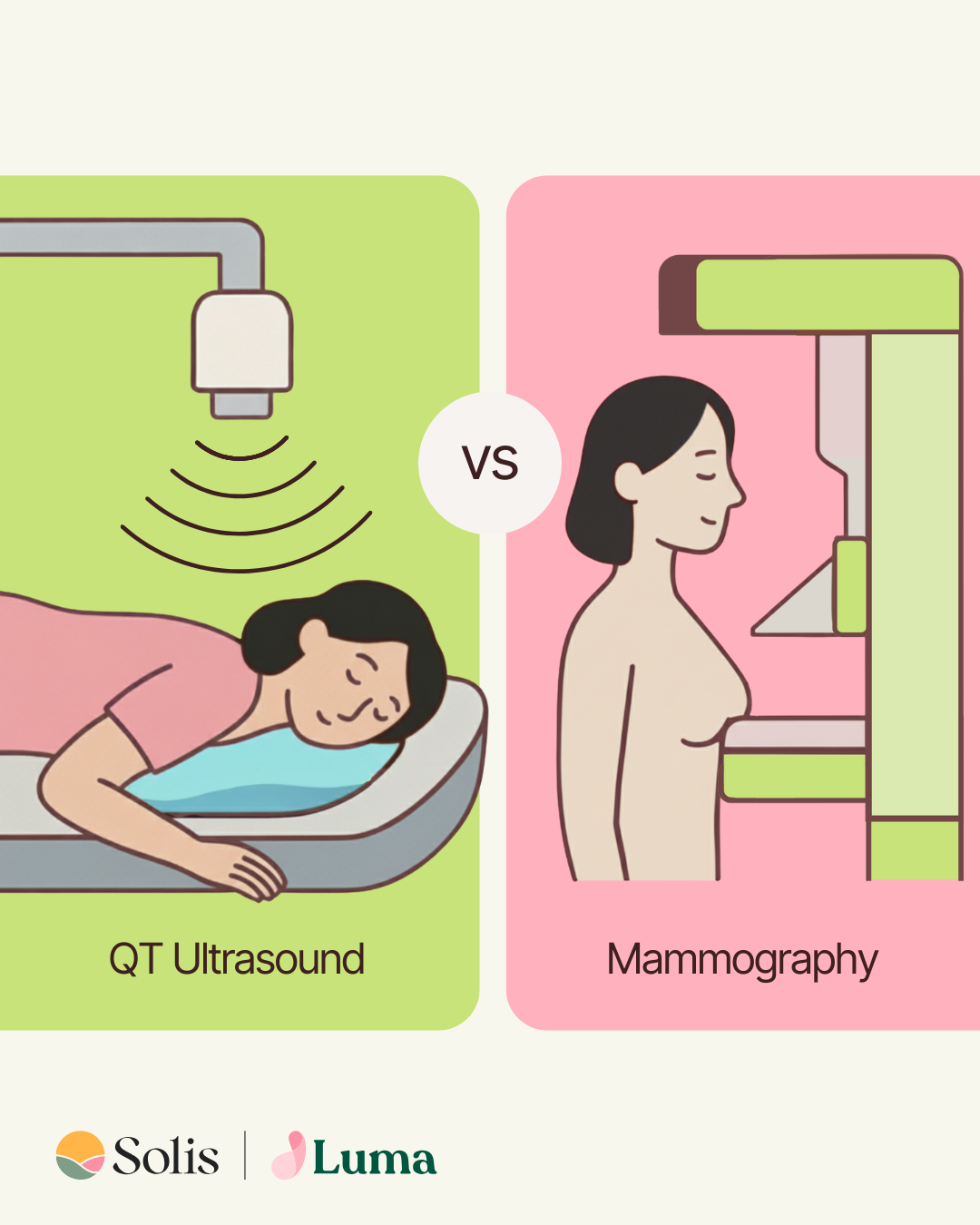
Mammography remains the only imaging method proven to reduce breast cancer deaths in large population studies [3] [4]. Conventional ultrasound is an established adjunct, particularly in women with dense breasts [5].
QT scanning offers theoretical advantages — no radiation, greater comfort, and possible benefits in dense tissue [2] [6] [7]. However, these claims remain preliminary. No current evidence shows improved cancer detection, mortality reduction, or cost effectiveness compared with established tools.
Why We Remain Cautious
- Unproven clinical outcomes: No studies yet show QT scanning improves survival or early detection [8].
- False positives: High-resolution data can increase over-diagnosis and unnecessary biopsies [9].
- Limited validation: Most studies are small or early-phase [1] [2].
- No guideline endorsement: Major societies, including the NCCN and American Cancer Society, have not added QT scanning to screening recommendations [4] [5].
- Access barriers: Availability, reimbursement, and standardization remain challenges [2].
Comfort Can’t Replace Confidence
Improving comfort and reducing radiation are worthy goals, but accuracy must come first. A test that feels better but misses cancers – or triggers false alarms – risks harming the very patients it aims to help.
Until QT scanning demonstrates outcomes equal to or better than mammography and ultrasound, it should remain an adjunct tool, used selectively and backed by ongoing clinical trials [10].
For now, mammography remains the gold standard, supported by decades of evidence and proven mortality reduction. Innovation is vital – but in medicine, innovation must be validated.
References
[1] Malik, B., Terry, R., Wiskin, J., & Lenox, M. (2018). Quantitative transmission ultrasound tomography: Imaging and performance characteristics. Medical Physics, 45(7), 3063–3075. https://doi.org/10.1002/mp.12957
[2] Malik, B., Iuanow, E., & Klock, J. (2020). An exploratory multi-reader, multi-case study comparing transmission ultrasound to mammography on recall rates and detection rates for breast cancer lesions. Academic Radiology. https://doi.org/10.1016/j.acra.2020.11.011
[3] Berry, D. A., Cronin, K. A., Plevritis, S. K., Fryback, D. G., Clarke, L., Zelen, M., Mandelblatt, J. S., Yakovlev, A. Y., Habbema, J. D. F., & Feuer, E. J. (2005). Effect of screening and adjuvant therapy on mortality from breast cancer. New England Journal of Medicine, 353(17), 1784–1792. https://doi.org/10.1056/nejmoa050518
[4] Oeffinger, K. C., Fontham, E. T. H., Etzioni, R., Herzig, A., Michaelson, J. S., Shih, Y.-C. T., Walter, L. C., Church, T. R., Flowers, C. R., LaMonte, S. J., Wolf, A. M. D., DeSantis, C., Lortet-Tieulent, J., Andrews, K., Manassaram-Baptiste, D., Saslow, D., Smith, R. A., Brawley, O. W., & Wender, R. (2015). Breast cancer screening for women at average risk. JAMA, 314(15), 1599. https://doi.org/10.1001/jama.2015.12783
[5] Bevers, T. B., Niell, B. L., Baker, J. L., Bennett, D. L., Bonaccio, E., Camp, M. S., Chikarmane, S., Conant, E. F., Eghtedari, M., Flanagan, M. R., Hawley, J., Helvie, M., Hodgkiss, L., Hoyt, T. L., Ivanovich, J., Jochelson, M. S., Kulkarni, S., Lancaster, R. B., Mauer, C., & Maxwell, J. (2023). NCCN Guidelines® insights: Breast cancer screening and diagnosis, version 1.2023: Featured updates to the NCCN Guidelines. Journal of the National Comprehensive Cancer Network, 21(9), 900–909. https://doi.org/10.6004/jnccn.2023.0046
[6] Iuanow, E., Pickup, E., Malik, B., Doehrmann, J., Huyke, F., Ducker, R., & Klock, J. (2024). Ultra-low frequency transmitted ultrasound breast imaging vs DBT (digital breast tomosynthesis): A patient-reported outcome study. Patient Related Outcome Measures, Volume 15, 219–240. https://doi.org/10.2147/prom.s423380
[7] Jiang, Y., Iuanow, E., Malik, B., & Klock, J. (2024). A multireader multicase (MRMC) receiver operating characteristic (ROC) study evaluating noninferiority of quantitative transmission (QT) ultrasound to digital breast tomosynthesis (DBT) on detection and recall of breast lesions. Academic Radiology. https://doi.org/10.1016/j.acra.2023.12.038
[8] Katz, D. S., & Hines, J. J. (2024). Current controversies in diagnostic and interventional radiology, an issue of Radiologic Clinics of North America. Elsevier Health Sciences.
[9] American College of Radiology. (2021). ACR practice parameter for the performance of a diagnostic breast ultrasound examination. https://gravitas.acr.org/PPTS/GetDocumentView?docId=124
[10] National Library of Medicine. (n.d.). Quantitative transmission imaging evaluation (QTIE study) compared with MRI as supplemental screening in patients with high lifetime risk of breast cancer (Clinical trial NCT07216274). ClinicalTrials.gov. https://clinicaltrials.gov/study/NCT07216274