




You survived cancer. But now, the thought of dating makes your chest tighten, because nothing feels the same.
“Will my lover accept my body as it is now?” “Will intimacy feel different?” “Am I still attractive?”
These questions that run through your mind, are more common than you might realise, and are often shared by many breast cancer survivors. But seen differently, this phase of life actually offers a meaningful opportunity: to connect with people who truly see and celebrate you.
At Solis, we often see that recovery doesn’t end with treatment — it continues as patients reconnect with their bodies and sense of self.
Finding Your Feet
“Can I truly be myself again?”
Breast cancer treatments can sometimes alter your body — scars, hair loss, changes in breast shape, or changes in sexual wellbeing [1]. Research shows it’s not unusual to feel out of sync with your body, or to look in the mirror and feel like a different person [2].
Coming back to yourself takes time and begins with small, intentional steps. Wear your favourite top, revisit hobbies that spark joy and attend events new to you [3].
Some women feel ready to date soon after treatment, while others take time to reconnect with themselves first [2]. Reclaiming your timeline means moving at your own pace for yourself. It’s not about meeting anyone else’s expectations. This self-assurance will carry into any relationship you choose to build.
Talking About Your Cancer Journey
“How much should I share about my cancer?”
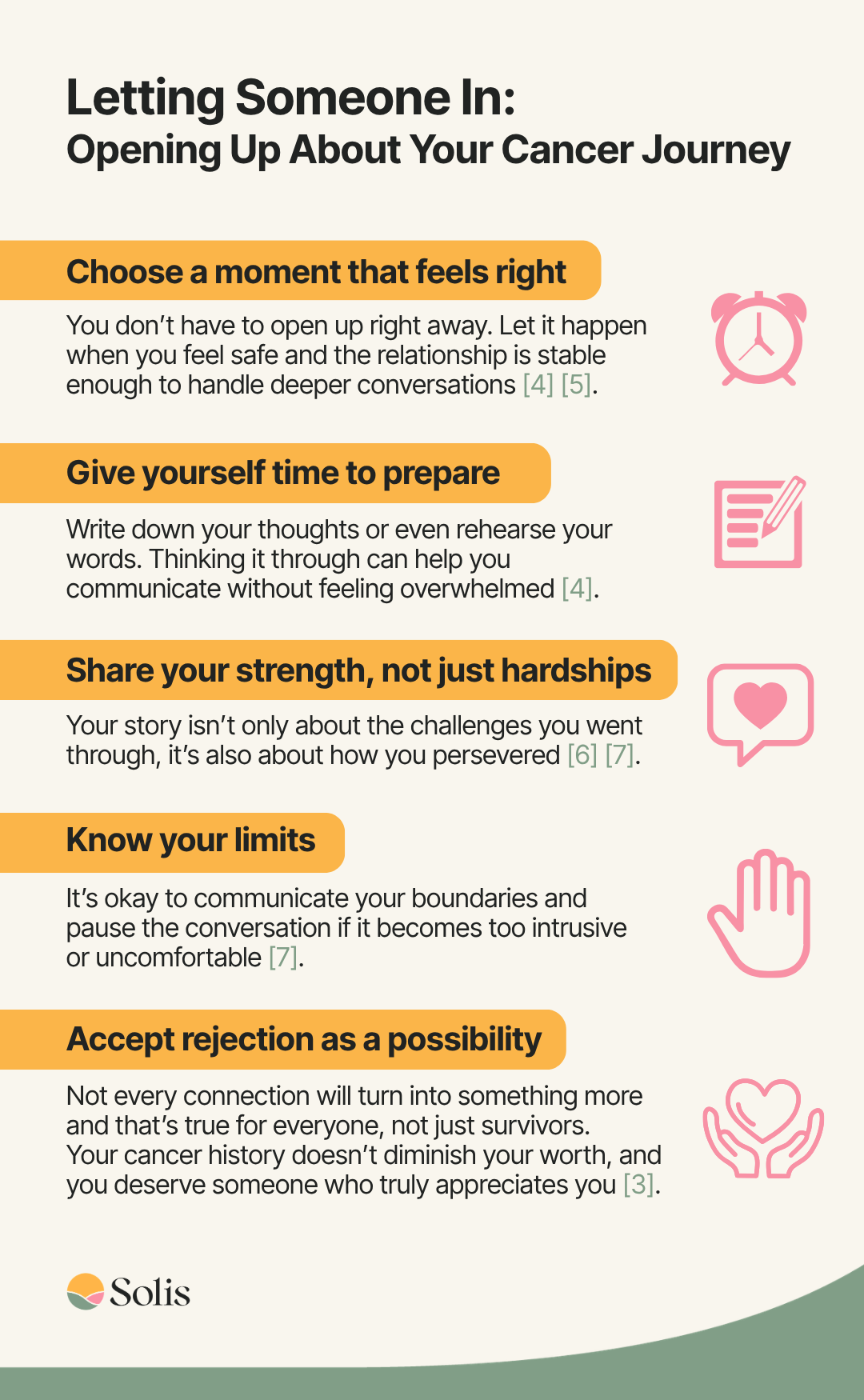
While chatting with someone new, you might wonder how much to share about your cancer, or worry about how it will be received [2] [3]. You might prefer to talk about it early on to get it out of the way, or wait until trust has been built.
There’s no perfect time nor script. When you do decide to share, some approaches that others have found helpful include:
Navigating Intimacy with Someone New
“What if I don’t want to be touched in certain areas?”
Physical intimacy after breast cancer brings up new questions.
While you may struggle with how you’re being perceived, your new partner may be worried about harming you, unsure how to approach scars, altered breasts or changes in sexual response [8] [9].
Many survivors find that honest communication can make a meaningful difference. Let your partner know what feels good, where you prefer to be touched and any physical limitations you’re navigating [10] [11].
Talking about changes like vaginal dryness or discomfort upfront allows you to find solutions — such as taking things slower or using lubricants — so intimacy feels safe, not something you have to endure [1] [12].
Self-Love as an Anchor
“Do I really need a partner to be happy?”
Entering new relationships may feel vulnerable, but it’s also an opportunity to be more intentional about who you let into your life [8]. When you’re clear on your worth, it becomes easier to recognise who truly respects it.
Some survivors find it helpful to resist pressure to settle just to meet the expectations of those around them. Look for someone who listens without judgment, respects boundaries and adapts alongside you [1] [2].
After everything you’ve been through, it’s natural to feel pressure to ‘get back’ to normal or tick boxes of what a meaningful life looks like. However, romantic or sexual relationships aren’t necessarily a requirement for wholeness or lasting joy [13]. They’re not the only yardsticks for your value, despite societal pressures to find a partner [14] [15].
Friendships, community and personal passions can be just as fulfilling and grounding [14]. When your life feels rich and steady, any relationship you enter becomes an addition, not something you rely on to feel complete.
Opening Your Heart Again
Starting something new after breast cancer takes courage. You deserve supportive intimacy that embraces your past, your present and everything you’re becoming.
The Breast Years of Your Life: Living Well After Cancer was created as a compassionate companion to this journey of self-discovery. It brings together practical tools, emotional support and gentle guidance from clinical and psychosocial perspectives to help you navigate love, intimacy and other aspects of life beyond cancer with confidence.
You don’t have to have everything figured out. Even allowing yourself to feel hopeful again is a step forward and something worth holding on to.
References
[1] Tan, Y. Y. & Lim, S. K. (Eds.). (2026). The Breast Years of Your Life: Living Well After Cancer. Epigram Books.
[2] Shaw, L.-K., Sherman, K. A., Fitness, J., & Breast Cancer Network Australia. (2016). Women’s experiences of dating after breast cancer. Journal of Psychosocial Oncology, 34(4), 318–335. https://doi.org/10.1080/07347332.2016.1193588
[3] American Cancer Society. (2025, April 15). Dating after cancer. https://www.cancer.org/cancer/managing-cancer/side-effects/sexual-side-effects/dating-after-cancer.html
[4] Centers for Disease Control and Prevention. (2024, July 1). Talking with Your Partner. https://www.cdc.gov/cancer-survivors/healthy-living-guides/talking-with-your-partner.html
[5] Kurowecki, D., & Fergus, K. D. (2013). Wearing my heart on my chest: dating, new relationships, and the reconfiguration of self-esteem after breast cancer. Psycho-Oncology, 23(1), 52–64. https://doi.org/10.1002/pon.3370
[6] İnan, F. S., & Ustun, B. (2014). Breast Cancer and Posttraumatic Growth. The Journal of Breast Health, 10(2), 75–78. https://pmc.ncbi.nlm.nih.gov/articles/PMC5351472/
[7] Beat Cancer EU. (2025, January 13). Dating as a Cancer Survivor: Overcoming Challenges, Building Connections, and Embracing Love. https://beatcancer.eu/resources/dating-as-a-cancer-survivor/
[8] Shaw, L.-K., Sherman, K., & Fitness, J. (2015). Dating concerns among women with breast cancer or with genetic breast cancer susceptibility: a review and meta-synthesis. Health Psychology Review, 9(4), 491–505. https://doi.org/10.1080/17437199.2015.1084891
[9] Jehan, M., Azam, S., Taimuri, M. A., Sumbal, A., Azhar, A., Amir, A., Oduoye, M. O., Zainab, A., Ikram, A., & Ali, T. (2024). Care for breast cancer survivors in Asian countries: A review of sexual dysfunction. Women’s Health, 20. https://doi.org/10.1177/17455057241237687
[10] Kaufman, R., Agrawal, L., Teplinsky, E., Kiel, L., Abioye, O., & Florez, N. (2024). From diagnosis to survivorship addressing the sexuality of women during cancer. The Oncologist. Advance online publication. https://doi.org/10.1093/oncolo/oyae242
[11] Perz, J., Ussher, J. M., & Gilbert, E. (2013). Constructions of sex and intimacy after cancer: Q methodology study of people with cancer, their partners, and health professionals. BMC Cancer, 13, 270. https://doi.org/10.1186/1471-2407-13-270
[12] Cleveland Clinic. (2026, February 2). Vaginal Dryness: Causes & Treatment. https://my.clevelandclinic.org/health/symptoms/21027-vaginal-dryness
[13] Walsh, L. C., Horton, C., Rodriguez, A., & Kaufman, V. A. (2023). Happily ever after for coupled and single adults: A comparative study using latent profile analysis. Journal of Social and Personal Relationships, 40(12). https://doi.org/10.1177/02654075231197728
[14] Dennett, B. E., Girme, Y. U., & Fabian, S. (2025). The good, the bad, and the complex: Qualitative accounts of how people navigate singlehood benefits and challenges. Journal of Social and Personal Relationships. https://doi.org/10.1177/02654075251351444
[15] Ginter, A. C., & Braun, B. (2016). Single Female Breast Cancer Patients’ Perspectives on Intimate Relationships. Qualitative Health Research, 27(10), 1461–1472. https://doi.org/10.1177/1049732316644431