






What Genetic Testing Can Tell You
When someone in your family has had breast cancer, it is almost instinctive to wonder whether you might be next. And with genetic testing becoming increasingly familiar, it is easy to assume that our genes can provide a straightforward answer. You may have heard of BRCA1 and BRCA2 or even considered getting tested yourself. But breast cancer is more complicated than a single “cancer gene”. Only a small proportion of breast cancers are linked to inherited genetic changes. Most arise from a combination of age, hormonal, environmental and other factors over a person’s lifetime. So, when does genetics really matter, and what can genetic testing actually tell you about your breast cancer risk?
Is breast cancer hereditary?
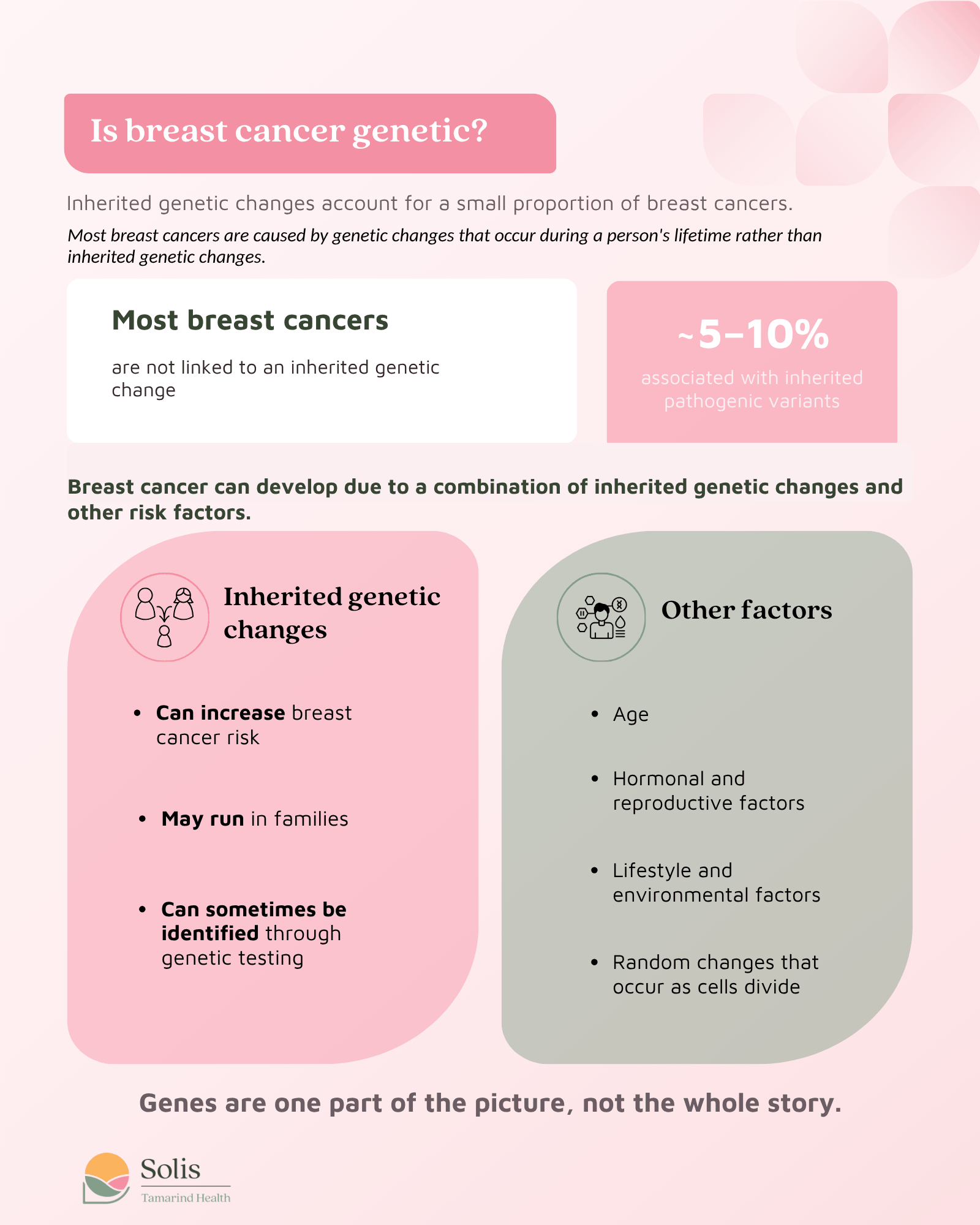
The short answer is: sometimes, but most of the time, no.
Around 5% to 10% of breast cancers are associated with inherited pathogenic variants in genes that can increase cancer risk. Most breast cancers, however, are not caused by a genetic change inherited from a parent.
This is an important distinction because having a relative with breast cancer does not automatically mean that you have inherited a breast cancer gene.
Breast cancer is also relatively common, particularly as people get older. It is therefore possible for more than one person in the same family to develop breast cancer without there being a hereditary cancer syndrome.
At the same time, some families do have patterns that suggest an inherited predisposition. This is where looking beyond the diagnosis itself, and considering who in the family developed cancer, what type of cancer they had and how old they were when diagnosed, can be helpful.
When does family history become more significant?
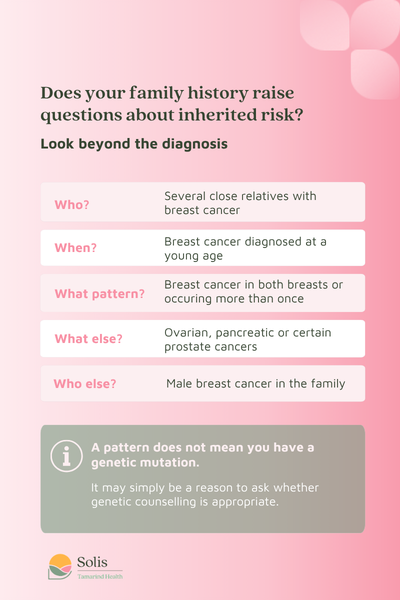
A family history may be more suggestive of inherited cancer risk when breast cancer
occurs:
- At a relatively young age
- In several close relatives
- In both breasts or more than once in the same person
- Alongside ovarian, fallopian tube or primary peritoneal cancer
- Alongside certain pancreatic or prostate cancers
- In a male relative
A known inherited mutation in the family, such as a BRCA1 or BRCA2 mutation, is another important reason to consider genetic counselling. But there is no single family-history rule that applies to everyone.
For example, having one parent or sibling who developed breast cancer does not automatically mean you need genetic testing. The age at diagnosis and the wider family pattern can make a difference.
In other words, family history is a starting point for a conversation, not a diagnosis.
BRCA1 and BRCA2: the genes most people have heard about
BRCA1 and BRCA2 are probably the genes most people associate with hereditary breast cancer.
Everyone has BRCA1 and BRCA2 genes, which help repair damaged DNA and protect against cancer. When a harmful mutation occurs in one of these genes, that protective function can be impaired, increasing the risk of developing breast and other cancers.
However, BRCA1 and BRCA2 are only part of the picture. Several other genes beyond BRCA1 and BRCA2 have also been linked to an increased risk of breast cancer, including PALB2, TP53, CHEK2 and others.
This is why genetic testing is not simply a matter of looking for a single “breast cancer gene”. Depending on an individual’s personal and family history, different genes may be relevant, and modern genetic testing often examines multiple genes associated with hereditary cancer risk.
Should I get genetic testing for breast cancer?
Genetic testing can provide valuable information about inherited cancer risk, but the decision to proceed should be made after discussion with a genetic counsellor or healthcare professional.
Factors such as your personal history of cancer, age at diagnosis, family history, the types of cancers seen in the family, how closely affected relatives are related to you, and any previous genetic test results may help determine whether testing is appropriate.
It’s also important to understand the possible outcomes of testing and what they may mean for you and your family. For example, finding a BRCA1 or BRCA2 mutation may influence future screening, risk-reducing surgeries, or testing for relatives.
Ultimately, genetic testing is a personal decision that should be made with a clear understanding of both its benefits and limitations.
What happens if genetic testing finds a mutation?
A positive genetic test does not mean that you have breast cancer or that you will definitely develop it.
It means you carry a genetic variant associated with an increased cancer risk. The level of risk varies depending on the specific gene involved and other personal and family factors.
Identifying a mutation can help guide medical decisions such as enhanced screening, risk reducing surgeries and medications, or, for individuals already diagnosed with cancer, treatment options that may be more effective for certain genetic mutations.
The results may also be relevant to family members who wish to better understand their own risk.
A positive result is not a diagnosis. Rather, it provides information that can help guide future healthcare decisions.
What if my genetic test is negative?
A positive genetic test does not mean that you have breast cancer or that you will definitely develop it.
It means you carry a genetic variant associated with an increased cancer risk. The level of risk varies depending on the specific gene involved and other personal and family factors.
Identifying a mutation can help guide medical decisions such as enhanced screening, risk reducing surgeries and medications, or, for individuals already diagnosed with cancer, treatment options that may be more effective for certain genetic mutations.
The results may also be relevant to family members who wish to better understand their own risk.
A positive result is not a diagnosis. Rather, it provides information that can help guide future healthcare decisions.
Frequently Asked Questions
What if my genetic test is negative?
A negative result can be reassuring, but it does not completely rule out an increased risk of breast cancer.
It simply means that no disease-causing mutation was identified in the genes analysed based on current knowledge and available testing methods.
Personal and family history still matter. In some families, cancer patterns may be linked to genetic factors that are not yet fully understood, while in others, shared lifestyle or environmental factors may play a role.
Genetic testing can refine our understanding of risk, but it cannot predict breast cancer with certainty.
What does a “variant of uncertain significance” mean?
Genetic testing can sometimes identify a change in a gene where there is not yet enough evidence to determine whether it affects cancer risk. This is known as a variant of uncertain significance (VUS).
A VUS is not the same as a harmful or pathogenic mutation and should not, on its own, be used to make major medical decisions.
Because these findings can be difficult to interpret, results should always be considered alongside personal and family history.
Genetic testing is not the same as testing a breast tumour
There is another distinction that can easily get lost when we talk about “genetic testing”.
Inherited genetic testing looks for genetic changes that are present in the body’s cells and may have been inherited from a parent.
Tumour testing, on the other hand, looks at genetic or molecular changes in cancer cells. These changes may have developed during a person’s lifetime and may not be inherited or passed on to their children.
The two types of testing can therefore answer very different questions.
Inherited testing asks: Could I have an inherited genetic predisposition to cancer?
Tumour testing asks:
What characteristics does this particular cancer have, and could they help guide treatment?
Understanding this distinction is important because inherited genetic testing and tumour testing answer different questions and serve different purposes in cancer care.
What if I have a breast lump? Should I get genetic testing?
This is where the distinction between risk assessment and diagnostic assessment becomes particularly important.
If you notice a new breast lump, persistent thickening, nipple discharge, skin change or another breast change, genetic testing does not tell you what that particular change is.
The priority is to have the change appropriately assessed. Depending on your age, symptoms and clinical findings, this may involve a clinical examination and breast imaging such as mammography or ultrasound.
If a suspicious area needs further investigation, a biopsy may be recommended to determine what the tissue represents.
Genetic testing may be considered separately if your personal or family history suggests an inherited risk.
In simple terms: genetic testing looks at your risk. Breast assessment looks at what is happening in your breast.
What if I have had a normal mammogram?
A normal mammogram is reassuring, but it should not be a reason to ignore a new or persistent breast change.
If you notice any of the abovementioned symptoms, or find something that is new or concerning, speak to a doctor even if your most recent breast imaging was normal.
Similarly, knowing that you do not carry a known inherited mutation does not mean that a new breast symptom can be dismissed.
So, what should you do if breast cancer runs in your family?
Start by understanding your family history.
If possible, find out:
Who had breast or other cancers?
What type of cancer did they have?
How old were they when they were diagnosed?
How many relatives were affected?
Share this information with your doctor. If the pattern suggests a possible inherited predisposition, you may be referred for genetic counselling or testing.
Where does genetic risk fit into breast cancer care?
We can coordinate genetic counselling and genetic testing when inherited risk is relevant, helping patients understand whether testing may be appropriate and what the results could mean for their breast care.
At Solis, we see genetic information as one part of the bigger picture. For someone concerned about a family history of breast cancer, genetic counselling and testing may be appropriate. For someone with a breast change or an abnormal imaging finding, the more immediate question may be what the finding means and whether further assessment is needed.
This may involve clinical examination, diagnostic imaging, image-guided biopsy and pathology.
The goal is not simply to identify a genetic mutation, but to understand how all the available information can guide personalised decisions about screening, risk reduction, diagnosis, and treatment.
At Solis Breast Care & Surgery Centre, our breast surgeons work closely with dedicated breast radiologists and pathology expertise at Luma Women’s Imaging Centre through the wider Solis and Luma network. Bringing these areas of expertise together allows breast findings to be considered in the context of the individual’s clinical history, imaging and, when needed, tissue diagnosis.
The bottom line
Having a family history of breast cancer does not automatically mean that you have inherited a cancer-predisposing gene. Likewise, a negative genetic test result does not mean that you have no risk.
Genetic testing can provide valuable information, particularly for individuals with a personal or family history suggestive of an inherited cancer predisposition. However, it is only one part of the overall picture and should be considered alongside your medical history, family history, and breast health.
Whether the concern arises from a family history of cancer, a genetic test result, an abnormal mammogram, or a new breast symptom, the key is understanding what it means for you and what steps, if any, should be taken next.
Article contributed and reviewed by Dr Lim Siew Kuan, Senior Consultant and Breast Surgeon at Solis Breast Care & Surgery Centre.
References
- National Cancer Institute. Genetics of Breast and Gynaecologic Cancers (PDQ®) – Health Professional Version.
- National Cancer Institute. Genetic Testing Fact Sheet.
- National Cancer Institute. BRCA Gene Changes: Cancer Risk and Genetic
Testing. - National Cancer Institute. Breast Cancer Treatment (PDQ®) – Health Professional
Version. - National Cancer Institute. Breast Cancer Causes and Risk Factors.
- American Society of Clinical Oncology. Assessing and Managing Your Patients’
Hereditary Cancer Risk.