






It’s a question many women quietly carry.
If you exercise regularly, eat well and feel generally healthy, breast cancer can seem distant – unlikely and almost unrelated to the life you’re living.
When a diagnosis happens in someone who appears fit and active, it can feel confusing. Some women may find themselves wondering what they did wrong, or what they could have done differently.
Can healthy women get breast cancer?
Yes. While lifestyle plays a role, breast cancer risk is influenced by a combination of factors – many of which are not always visible or within our control.
Why Breast Cancer Risk is More Complex Than Lifestyle Alone
There is comfort in the belief that health is something we can control. Eat nourishing food, stay active and avoid unhealthy habits – we reassure ourselves that we are doing what we can to stay well.
However, breast cancer risk factors extend beyond lifestyle alone. You can learn more about these in our breast health guides.
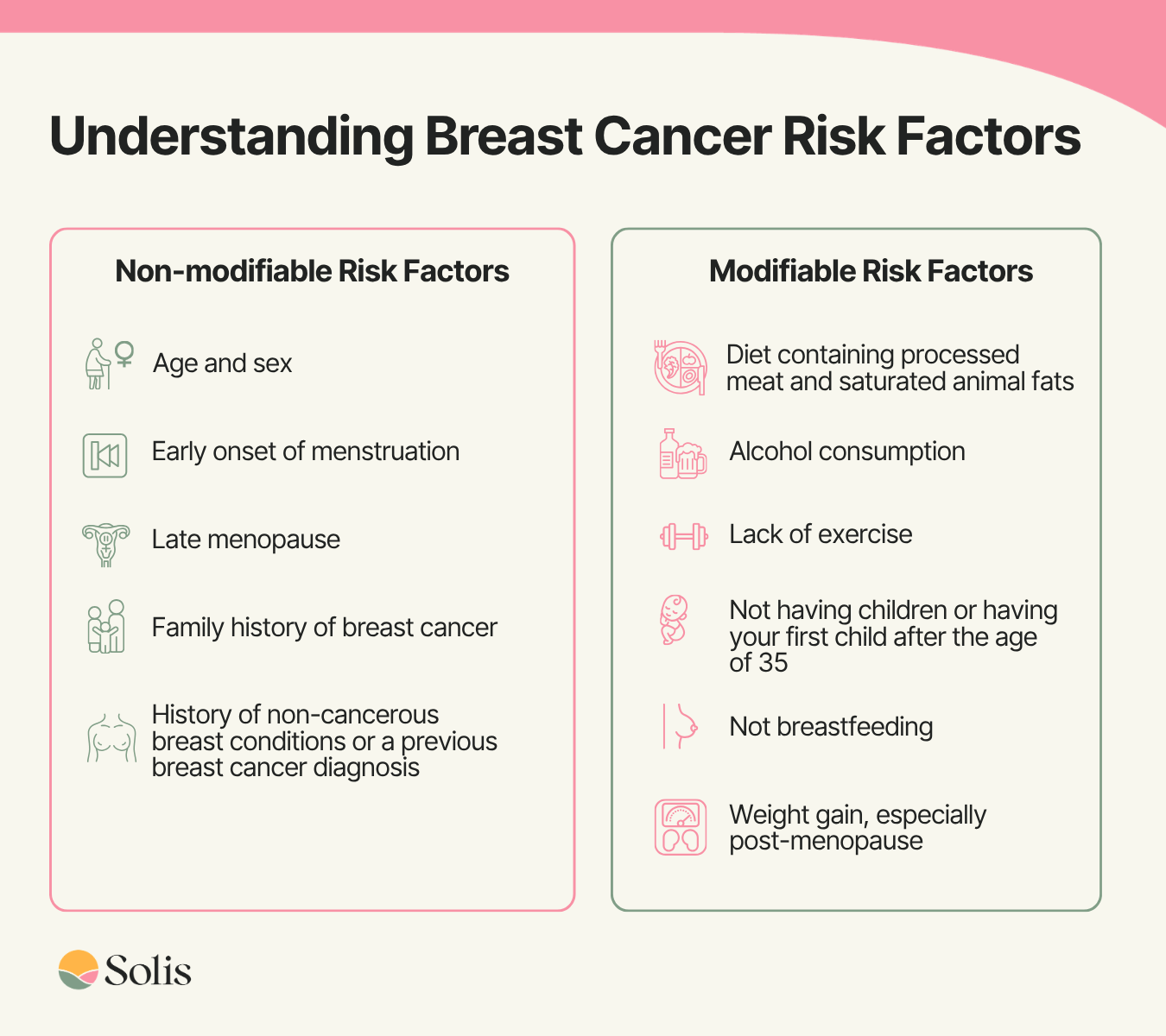
Non-modifiable factors include [1] [2]:
- Age and sex
- Early onset of menstruation
- Late menopause
- Family history of breast cancer
- History of non-cancerous breast conditions or a previous breast cancer diagnosis
Modifiable factors include [1] [2]:
- Diet containing processed meat and saturated animal fats
- Alcohol consumption
- Lack of exercise
- Not having children or having your first child after the age of 35
- Not breastfeeding
- Weight gain, especially post-menopause
Contrary to popular belief, only about 5-10% of breast cancers are due to inherited gene mutations [3]. That means many women diagnosed with breast cancer do not have a known family history.
This complexity makes it difficult to assess breast cancer risk based on outward appearance, lifestyle or even family history alone.
When Feeling Healthy Doesn’t Tell the Full Story
Breast cancer does not always present as a lump, and it may develop quietly [4]. In its early stages, it may not cause pain or obvious symptoms. Daily life can feel completely normal, with no clear sign that something is wrong.
Often, subtle changes are first noticed during everyday routines – such as showering or getting dressed – but it is easy to hesitate or dismiss them.
Feeling healthy can create reassurance. However, it may also lead to delayed action when something feels different. Research shows that many women do not perceive themselves to be at risk of breast cancer, and may only associate breast checks with noticeable symptoms [5].
Breast Awareness: Familiarity, Not Fear
Breast awareness is not about constant checking or anxiety. It’s about becoming familiar with what is normal for your own body. Knowing how your breasts typically look and feel makes it easier to notice when something is different [6].
Not every change is cause for alarm. Many breast changes are non-cancerous and can be due to hormonal fluctuations or benign conditions [7]. However, if something feels unusual or does not go away, it is worth having it assessed.
Regular screening also plays an important role. Some changes cannot be felt or seen externally, and imaging such as a mammogram screening in Singapore provides another layer of detection – supporting earlier diagnosis and peace of mind.
Moving Away from Self-Blame

When a diagnosis happens, it is common to look back and question your choices. Could this have been prevented? Was there something I missed? If I had done things differently, would the outcome have changed?
This search for answers is a natural response, especially for conditions like breast cancer where there is often no single, clear cause. In trying to make sense of it, many women may turn the question inward [8].
These thoughts are normal, but they can also be heavy and may lead to feelings of guilt or self-blame [9]. In reality, breast cancer often develops through a complex interaction of genetic, hormonal, environmental and lifestyle factors over time [10].
Understanding this can help shift the narrative away from blame and towards clarity. It allows space for a more compassionate perspective – one that recognises that health is not always a direct reflection of effort, and that illness is not a personal failure.
Understanding Risk, Even When You Feel Well
Breast cancer risk cannot always be predicted by appearance, lifestyle or perceived health. Recognising this helps close the gap between expectation and reality, and supports more informed conversations about breast health.
Seeking Clarity in Uncertainty

If you notice changes in your body, or have burning questions about your breast cancer risk, speaking with a breast specialist can be a meaningful first step.
Our team is here to support you with care and clarity – so you can make informed decisions about your health with confidence.
References
[1] Solis Breast Care & Surgery Centre. (2024). My Breast Health Guide. https://www.solis.sg/resources/#
[2] Mayo Clinic. (2025, July 26). Breast cancer. https://www.mayoclinic.org/diseases-conditions/breast-cancer/symptoms-causes/syc-20352470
[3] Apostolou, P., & Fostira, F. (2013, March 21). Hereditary Breast Cancer: The Era of New Susceptibility Genes. BioMed Research International, 2013, 1–11. https://doi.org/10.1155/2013/747318
[4] Malherbe, F., Nel, D., Molabe, H., Cairncross, L., & Roodt, L. (2022). Palpable breast lumps: An age-based approach to evaluation and diagnosis. South African Family Practice, 64(1), 5571. https://doi.org/10.4102/safp.v64i1.5571
[5] Liow, J. J. K., Lim, Z. L., Ho, P. J., Goh, S.-A., Murali, S., Tan, B. K. T., Tan, V. K. M., Hartman, M., Li, J., & McCrickerd, K. (2022). Attitudes and barriers to mammography screening in Singaporean women through the eyes of their adult children: A focus group study. SSM – Qualitative Research in Health, 2, 100168. https://doi.org/10.1016/j.ssmqr.2022.100168
[6] Cleveland Clinic. (2025, August 25). Breast Self-Exam. https://my.clevelandclinic.org/health/diagnostics/3990-breast-self-exam
[7] National Cancer Institute. (2024, January). Understanding Breast Changes and Conditions: A Health Guide. https://www.cancer.gov/types/breast/breast-changes/understanding-breast-changes.pdf
[8] Bennett, K. K., Compas, B. E., Beckjord, E., & Glinder, J. G. (2005). Self-Blame and Distress Among Women with Newly Diagnosed Breast Cancer. Journal of Behavioral Medicine, 28(4), 313–323. https://doi.org/10.1007/s10865-005-9000-0
[9] Gulyn, L. M., & Youssef, F. (2010). Attribution of Blame for Breast and Lung Cancers in Women. Journal of Psychosocial Oncology, 28(3), 291–301. https://doi.org/10.1080/07347331003689052
[10] Alkabban, F. M., Ferguson, T., & Menon, G. (2024, February 25). Breast Cancer. National Library of Medicine; StatPearls Publishing. https://www.ncbi.nlm.nih.gov/books/NBK482286/