






A breast cancer diagnosis can bring with it a whirlwind of emotions, appointments and information. In what can feel like the blink of an eye, you may find yourself discussing surgery, medications or treatment plans that could have ripple effects on your health, daily life and future plans
Many women expect that once a diagnosis is confirmed, there will be one clear path forward. Instead, they are sometimes presented with choices, and with those choices comes an unexpected question: “How do I know I’m making the right decision?”
If you’ve ever felt overwhelmed or worried about choosing the “wrong” treatment, know that you are not alone. Women facing breast cancer treatment decisions commonly experience uncertainty, anxiety and ongoing worry as they try to balance medical information with what feels right for them and their families [1][2][3].
Many women arrive at this stage after a period of uncertainty, additional investigations or follow-up appointments. If that’s where you are now, our article on what to do when rest results aren’t clear explains what often happens before treatment decisions are discussed.
Should You Get a Second Opinion for Breast Cancer?
One of the most common questions women ask after a breast cancer diagnosis is whether they should seek a second opinion.
There is no universal rule that every patient needs one. However, many women choose to seek a second opinion when they want additional reassurance, when several treatment options are available, or when they are unsure they fully understand their diagnosis or treatment recommendations.
Importantly, seeking a second opinion does not mean you distrust your doctor. Rather, it is a recognised part of breast cancer care that can help patients better understand their situation and feel more confident about the decisions ahead [4][5].
In many cases, the second opinion confirms the original diagnosis or treatment plan. While this may not change the treatment itself, it often changes how patients feel about moving forward. Knowing that two specialists have independently arrived at similar conclusions can provide valuable reassurance during a time of uncertainty [4][6].
Occasionally, a second opinion may also identify additional treatment options or alternative approaches that are equally supported by current evidence [5][6][7].
Ultimately, the goal is not necessarily to find a different answer. It is to ensure you fully understand your diagnosis and feel confident about your next step.
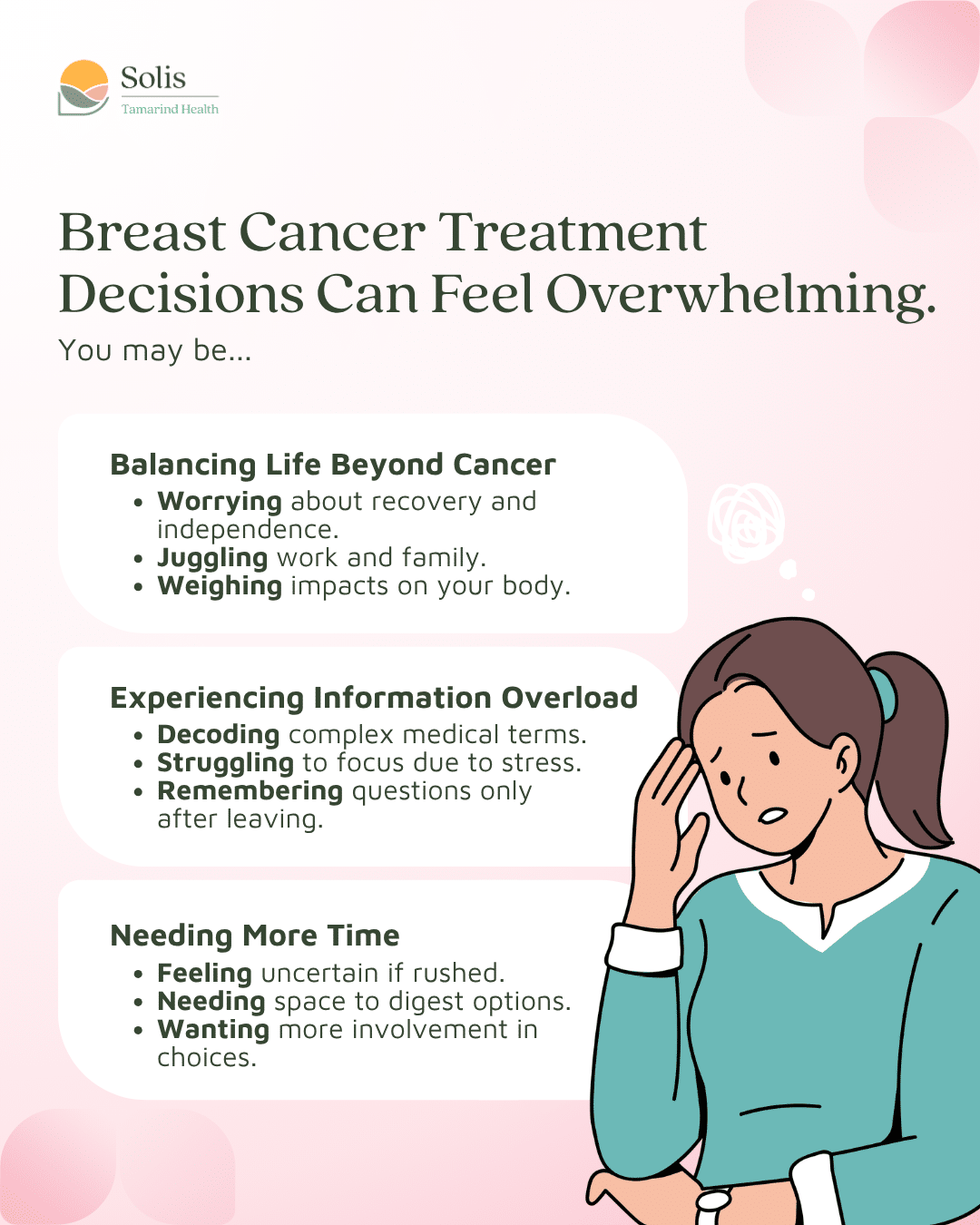
When Breast Cancer Treatment Decisions Feel Overwhelming
Treatment decisions are rarely just about treating the cancer. They are also about understanding how different options may affect the life you hope to return to afterwards.
You may find yourself thinking about your recovery, your independence, your family responsibilities, your work, or how treatment could affect your body and quality of life [2]. Surgery, chemotherapy, radiotherapy and other treatments each come with their own benefits, considerations and potential side effects, and these may matter differently from one person to another [3].
At the same time, you are often trying to process unfamiliar medical terms and a large amount of information within a short consultation. It’s therefore perfectly normal to leave an appointment only to think of new questions once you’re home. This isn’t a sign that you weren’t listening. Rather, it reflects how emotional stress can affect the way we absorb and process information.
Evidence indicates that patients who are not given adequate time to process information and participate in treatment decisions are more likely to experience uncertainty and feel less involved in their care [1][8][9].
Why Breast Cancer Treatment Plans May Not Be the Same for Everyone
Many people assume there is only one “correct” treatment for breast cancer. In reality, there may be more than one appropriate option depending on factors such as the type and stage of breast cancer, tumour biology, your overall health, and your personal priorities [10].
For example, some women may be suitable candidates for either breast-conserving surgery or a mastectomy. Both may be medically appropriate, but each comes with different considerations that extend beyond cancer treatment alone, including recovery, body image, future treatment needs and personal preferences [3].
This is where shared decision-making becomes important. Rather than choosing a treatment based solely on clinical evidence, doctors also work with patients to understand what matters most to them. For some women, preserving the breast may feel important. For others, reducing the likelihood of another surgery may bring greater peace of mind.
The goal is not simply to identify a medically appropriate treatment, but one that also aligns with your individual circumstances, priorities and values.

Can You Get a Second Opinion for Breast Cancer in Singapore?
Patients in Singapore are free to seek a second opinion if they would like further clarification about their diagnosis or treatment options.
This typically involves another breast specialist reviewing existing medical records, imaging studies, pathology reports and treatment recommendations before providing an independent assessment.
Many patients seek a second opinion not because they wish to change doctors, but because they want greater clarity about their options before making important treatment decisions.
Whether the second opinion confirms the original recommendation or presents additional considerations, the process can help patients feel more informed and reassured about the path they ultimately choose.
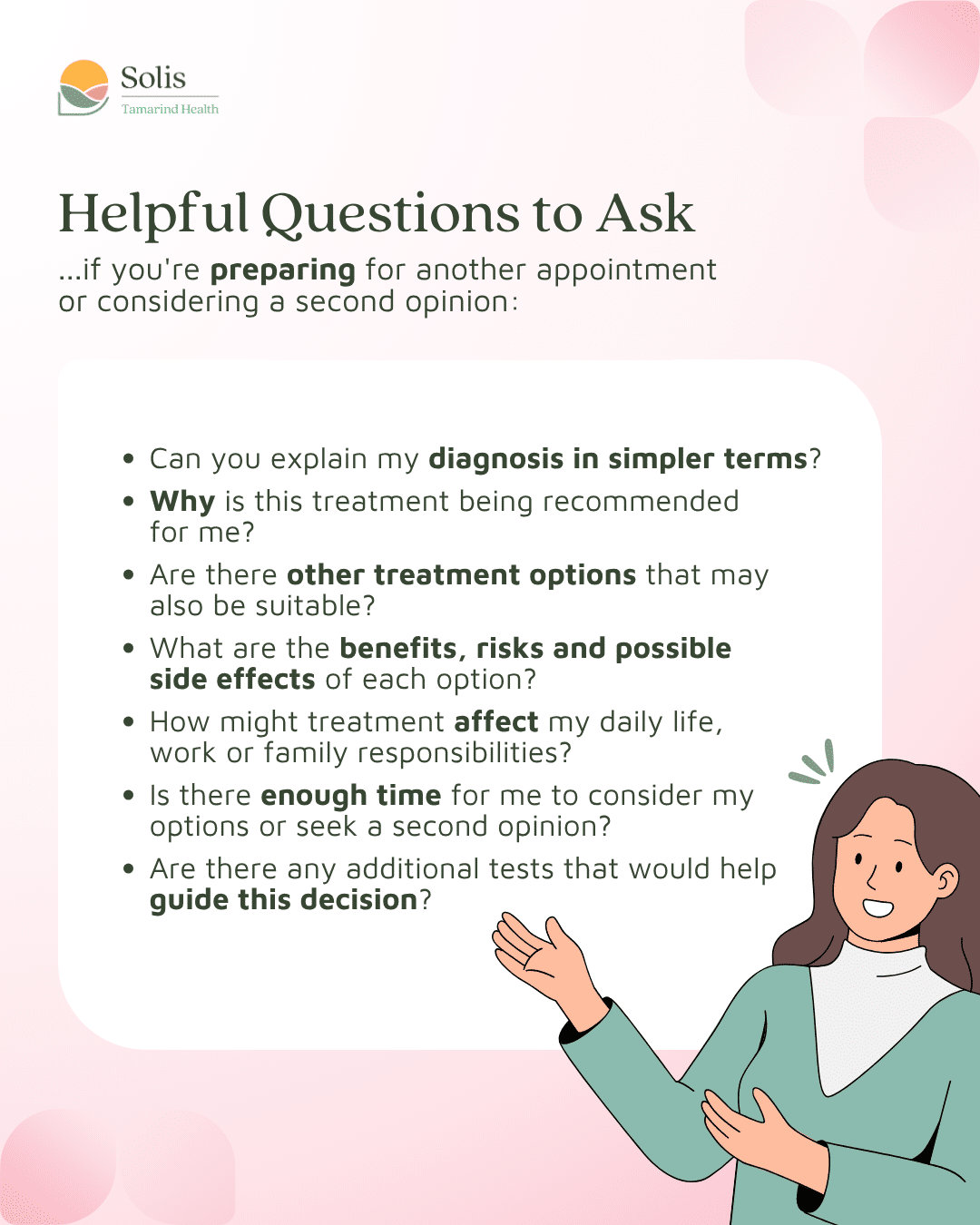
Questions Many Women Wish They Had Asked Sooner
As the initial shock settles and you’ve had time to reflect, new concerns often come to mind. This highlights the importance of having enough time to process information before moving forward [9][11].
If you’re preparing for another appointment or considering a second opinion, you may find it helpful to ask questions such as: [6]
- Can you explain my diagnosis in simpler terms?
- Why is this treatment being recommended for me?
- Are there other treatment options that may also be suitable?
- What are the benefits, risks and possible side effects of each option?
- How might treatment affect my daily life, work or family responsibilities?
- Is there enough time for me to consider my options or seek a second opinion?
- Are there any additional tests that would help guide this decision?
No question is too small. Understanding the reasons behind a recommendation can often bring greater clarity and reassurance than simply hearing the recommendation itself.
What Does Decision Confidence Mean
Decision confidence does not mean feeling completely certain or never experiencing fear. Few people feel that way after a breast cancer diagnosis.
Instead, confidence comes from knowing that you have been given the opportunity to understand your options, ask the questions that matter to you and make a decision that reflects both sound medical advice and your own priorities.
Research has found that patients who are involved in decisions to the extent they wish to be are often more satisfied with their care and less likely to experience regret about their treatment choices later on [3][8].

Why Seeking More Information Is Not the Same as Delaying Care
Many patients worry that taking more time to ask questions or seek a second opinion will slow down their treatment.
While every situation is unique, there is often an appropriate window to better understand your diagnosis before moving forward with treatment. Taking the time to understand your options should never be mistaken for avoiding treatment. Rather, it is about ensuring that when you move forward, you do so with confidence instead of uncertainty.
Breast cancer treatment decisions rarely feel easy. However, confidence does not come from having all the answers immediately. It comes from having the opportunity to understand your options, ask questions, seek clarification when needed and make decisions that align with both medical evidence and your personal priorities.
Whether you are considering a second opinion or simply looking for more clarity about your treatment options, our breast specialists at Solis Breast Care & Surgery Centre in Singapore are here to support you with the information, time and guidance needed to help you move forward with confidence.
References
[1] Rivers, A. S., & Sanford, K. (2021). A special kind of stress: Assessing feelings of decisional distress for breast cancer treatment decisions. Patient Education and Counseling. https://doi.org/10.1016/j.pec.2021.04.020
[2] Reyna, V. F., Nelson, W. L., Han, P. K., & Pignone, M. P. (2015). Decision Making and Cancer. The American Psychologist, 70(2), 105–118. https://doi.org/10.1037/a0036834
[3] Cheng, Q., Jiang, Q., Chen, X., Hu, X., Xia, M., & Jiao, Y. (2025). Early decision regret and its relationship with decision participation among breast cancer patients undergoing surgery. The Breast, 84, 104585. https://doi.org/10.1016/j.breast.2025.104585
[4] Beer, M., Allison, H., Fisher, C., & Fan, B. (2022). Second Opinions in Breast Cancer Surgery: What Have We Learned? Cureus. https://doi.org/10.7759/cureus.30180
[5] National Cancer Institute – NCI Dictionary of Cancer Terms. (2025). Second Opinion. https://www.cancer.gov/publications/dictionaries/cancer-terms/def/second-opinion
[6] Cleveland Clinic. (2025, April 2). What To Know About Getting a Breast Cancer Second Opinion. https://health.clevelandclinic.org/breast-cancer-second-opinion
[7] Varman, P. M., Conner, A., Bennett, W. C., Taft, D., Chichura, A. M., Wu, V., Escobar, P., Woo, K. P., Cech, A., Rosenberg, C., & Zahraa Al-Hilli. (2025). Impact of Second Opinions on Time to Treatment of Breast Cancer. Annals of Surgical Oncology, 32(11), 8286–8294. https://doi.org/10.1245/s10434-025-17934-1
[8] Stacey, D., Paquet, L., & Samant, R. (2010). Exploring Cancer Treatment Decision-Making by Patients: A Descriptive Study. Current Oncology, 17(4). https://doi.org/10.3747/co.v17i4.527
[9] Herrmann, A., Sanson-Fisher, R., & Hall, A. (2019). Not having adequate time to make a treatment decision can impact on cancer patients’ care experience: Results of a cross-sectional study. Patient Education and Counseling, 102(11), 1957–1960. https://doi.org/10.1016/j.pec.2019.06.011
[10] Mayo Clinic. (2025, January 10). Breast Cancer – Diagnosis and Treatment. https://www.mayoclinic.org/diseases-conditions/breast-cancer/diagnosis-treatment/drc-20352475
[11] Huijgens, F. L., Hillen, M. A., Huisinga, M. J., Vis, A. N., Tillier, C. N., Oldenburg, H. S. A., Diepenhorst, G. M. P., & Henselmans, I. (2025). Cancer Patients’ Experiences of Burden when Involved in Treatment Decision Making. Medical Decision Making, 45(5), 533-544. https://doi.org/10.1177/0272989×251334979